Implementing NetSuite is one of the most significant transformations an organization can undertake. While technology is the enabler, the real driver of success lies in the people leading the project. Defining clear NetSuite implementation team roles ensures accountability, reduces project risk, and accelerates adoption.
This matters: Gartner predicts that by 2027, over 70% of ERP initiatives will fall short of their business objectives, with up to 25% failing catastrophically. Role clarity and leadership are pivotal to avoiding those pitfalls.
Many businesses mistakenly focus only on choosing the right ERP solution and overlook the importance of building the right team. The result is often budget overruns, missed deadlines, and frustrated end users. By contrast, companies establishing structured team roles, from executive sponsors to finance leads, see smoother deployments and higher ROI.
This blog outlines the critical NetSuite implementation team roles, responsibilities, and how each contributes to project success.
Why are NetSuite Implementation Team Roles Crucial?
ERP success depends on each role playing its part. Assigning responsibilities is more than a formality; it’s the foundation of the entire project.
Here’s why role definition matters:
Project Efficiency: Clear ownership prevents overlap, reduces delays, and keeps the implementation on track.
Accountability: When responsibilities are defined, team members take ownership, reducing errors and missed steps.
Predictability: Project leaders can track progress, anticipate challenges, and allocate resources effectively.
Collaboration: Defined roles streamline communication, making it easy to know who to approach for decisions or updates.
Stakeholder confidence: A structured team builds trust with executives, investors, and partners.
In short, defining your NetSuite implementation team roles is the bedrock of ERP success. Without this clarity, efficiency, communication, and stakeholder confidence all suffer.
What Roles Are Needed in a NetSuite Implementation Team?
A NetSuite project is multi-layered and requires contributions from executive sponsors, functional experts, and technical leads. Below are the essential implementation team roles and how each supports ERP success.
1. The Role of the C-Suite: Vision and Sponsorship
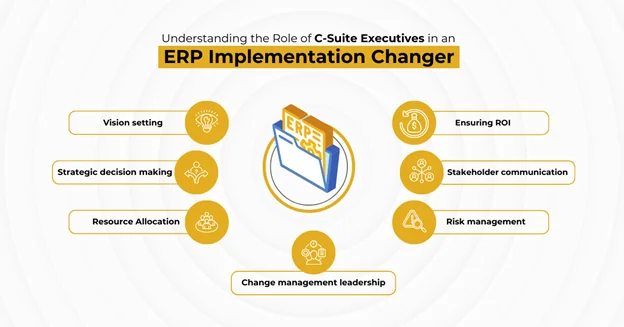
C-Suite executives are not involved in daily configurations, but their influence defines the project’s trajectory. They ensure the initiative drives measurable ROI by setting a clear ERP vision, securing funding, and aligning implementation with long-term strategy.
Their responsibilities extend beyond approvals; they act as change leaders, addressing resistance, championing adoption, and communicating progress to boards and investors. Without executive sponsorship, even the most well-planned project risks losing momentum.
2. IT Managers and Directors: Technical Gatekeepers
IT leaders safeguard the technical success of a NetSuite rollout. They evaluate existing systems, design integrations, and maintain cybersecurity standards. Their oversight ensures the ERP connects seamlessly with CRMs, finance systems, and operational tools.
Additionally, IT managers coordinate vendor relationships, manage system troubleshooting, and train internal technical teams. By bridging external consultants and internal staff, they guarantee that technical decisions support business goals rather than becoming isolated IT projects.
Streamline your NetSuite Implementation Journey!
Ready to build your dream team for NetSuite implementation success? Partner with AlphaBOLD for expert Project Management and Resource Planning services. Let's embark on your journey together!
No ERP transformation succeeds without a strong Project Manager. Acting as the central coordinator, they oversee planning, track milestones, manage risks, and ensure the project remains on time and within budget.
Beyond scheduling tasks, Project Managers balance the needs of executives, IT, finance, and end users. They anticipate roadblocks, mitigate risks, and maintain quality control. Once the system is deployed, they manage handover and post-implementation reviews, ensuring lessons learned inform future initiatives.
4. Business Analysts: Translating Needs into Solutions
Business Analysts connect organizational requirements with NetSuite’s technical capabilities. Through interviews, workshops, and workflow analysis, they capture business needs and transform them into ERP configurations that reflect real-world operations.
Their work goes beyond documentation; they identify opportunities for process improvement, helping organizations move from “technology replacement” to genuine business optimization. In many cases, Business Analysts prevent costly rework by ensuring configurations align with the company’s goals from day one.
5. Finance Executives: Guardians of ROI
ERP initiatives are as much financial as they are technical. Finance leaders set budgets, monitor costs, and ensure spending delivers measurable value. Their oversight keeps the project aligned with financial constraints while safeguarding profitability.
Equally important, Finance Executives establish ROI benchmarks and track outcomes once NetSuite goes live. This ensures the ERP is implemented and delivers the cost savings, efficiency, and financial visibility it promised at the outset.
Seeking to optimize your team's performance for NetSuite implementation? Leverage AlphaBOLD's Project Management and Resource Planning services for a tailored approach. Elevate your implementation journey.
Every role in a NetSuite implementation contributes to a larger outcome: C-Suite executives provide strategic sponsorship, IT leaders secure technical integrity, Project Managers ensure delivery, Business Analysts bridge business and technology, and Finance Executives track ROI.
A project succeeds only when these roles align under a shared vision. With AlphaBOLD’s expertise, organizations gain a technology partner and a strategic advisor who helps assemble the right team for ERP success.
FAQs on NetSuite Implementation Team Roles
Who should be part of a NetSuite implementation team?
A balanced team includes executive sponsors, Project Managers, IT leaders, Business Analysts, Finance Executives, and external consultants when needed.
Why are defined roles critical for ERP success?
Defined roles reduce miscommunication, ensure accountability, and streamline collaboration, making the project more predictable and efficient.
Can a NetSuite project succeed without executive sponsorship?
No. Without C-Suite backing, projects often lack funding, direction, and employee adoption.
Should internal teams or external consultants lead the project?
A hybrid model is ideal. Internal stakeholders understand the business, while consultants bring specialized NetSuite expertise.
What is the most overlooked team role in ERP projects?
Change management leadership, ensuring users adopt the new system smoothly.
To provide the best experiences, we use technologies like cookies to store and/or access device information. Consenting to these technologies will allow us to process data such as browsing behavior or unique IDs on this site. Not consenting or withdrawing consent, may adversely affect certain features and functions.
Functional
Always active
The technical storage or access is strictly necessary for the legitimate purpose of enabling the use of a specific service explicitly requested by the subscriber or user, or for the sole purpose of carrying out the transmission of a communication over an electronic communications network.
Preferences
The technical storage or access is necessary for the legitimate purpose of storing preferences that are not requested by the subscriber or user.
Statistics
The technical storage or access that is used exclusively for statistical purposes.The technical storage or access that is used exclusively for anonymous statistical purposes. Without a subpoena, voluntary compliance on the part of your Internet Service Provider, or additional records from a third party, information stored or retrieved for this purpose alone cannot usually be used to identify you.
Marketing
The technical storage or access is required to create user profiles to send advertising, or to track the user on a website or across several websites for similar marketing purposes.
To provide the best experiences, we use technologies like cookies to store and/or access device information. Consenting to these technologies will allow us to process data such as browsing behavior or unique IDs on this site. Not consenting or withdrawing consent, may adversely affect certain features and functions.
Functional
Always active
The technical storage or access is strictly necessary for the legitimate purpose of enabling the use of a specific service explicitly requested by the subscriber or user, or for the sole purpose of carrying out the transmission of a communication over an electronic communications network.
Preferences
The technical storage or access is necessary for the legitimate purpose of storing preferences that are not requested by the subscriber or user.
Statistics
The technical storage or access that is used exclusively for statistical purposes.The technical storage or access that is used exclusively for anonymous statistical purposes. Without a subpoena, voluntary compliance on the part of your Internet Service Provider, or additional records from a third party, information stored or retrieved for this purpose alone cannot usually be used to identify you.
Marketing
The technical storage or access is required to create user profiles to send advertising, or to track the user on a website or across several websites for similar marketing purposes.