

Table of Contents
Introduction
Shopify is one of the world’s largest e-commerce platforms, supporting millions of businesses in more than 175 countries. As brands continue to expand across online and retail channels, Shopify has become a vital platform for managing sales, inventory, and customer engagement within a unified environment.
For companies using NetSuite as their ERP, achieving seamless Shopify integration with NetSuite is essential to streamline operations, improve data accuracy, and accelerate fulfillment. Connecting these two systems enables real-time synchronization of orders, inventory, and financial data while eliminating manual work and ensuring consistent information across all departments.
This article explores the key methods, benefits, and considerations for implementing Shopify integration with NetSuite. It also includes insights from AlphaBOLD’s consulting experience to help businesses select the right approach for their operational and growth needs.
Shopify Integration with NetSuite: Key Methods
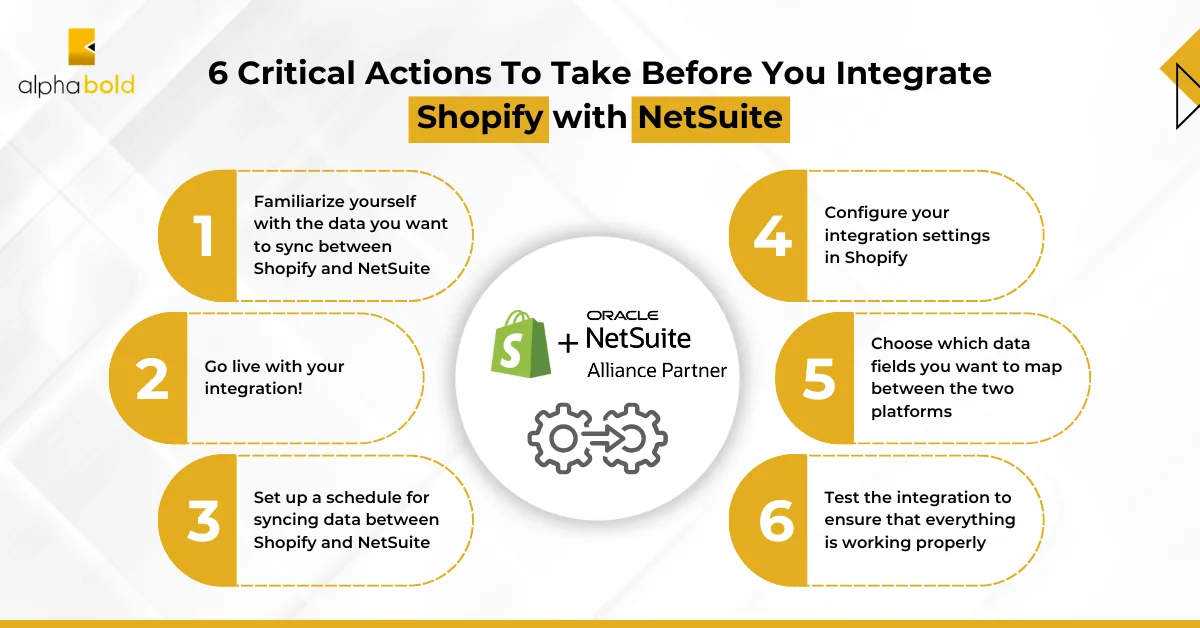
There are several methods for integrating NetSuite with Shopify, and at AlphaBOLD, we have hands-on experience with all of them. Many of our clients were already using Shopify before adopting NetSuite or implemented both platforms together. Our consulting teams have helped them choose and deploy integration solutions that deliver real-time visibility, faster fulfillment, and more accurate reporting across their sales and finance operations. Below are the primary Shopify integration with NetSuite methods:
1. Shopify Connector by NetSuite
NetSuite offers its own integration solution, the NetSuite Connector, a pre-built tool that connects NetSuite with Shopify and other third-party platforms. Originally developed as FarApp and now fully integrated into NetSuite, this connector synchronizes product, inventory, customer, and order data between the two systems. Recent updates have improved flexibility through custom field mapping, multi-location inventory management, and Shopify B2B compatibility. It remains the most direct and officially supported method for integrating Shopify with NetSuite.
2. Integration Platform or iPaaS
Integration Platform or iPaaS (Integration Platform as a Service): Platforms such as Boomi, Celigo, and MuleSoft allow businesses to connect NetSuite with Shopify and other systems through centralized automation. These tools provide pre-built API connectors and visual flow designers that simplify configuration, monitoring, and data mapping. Many iPaaS solutions now include advanced features like AI-assisted error handling and workflow orchestration, making them ideal for organizations managing multiple storefronts or complex data ecosystems.
3. Third-Party Integration Solutions
Third-Party Integration Solutions: Several third-party applications available on the NetSuite SuiteApp Marketplace and Shopify App Store provide pre-built connectors for Shopify integration with NetSuite. These tools are often built for specific business cases such as order syncing, inventory management, or financial reconciliation. While many offer customization, scalability and long-term support can vary by vendor, so it is important to evaluate reliability, update frequency, and customer support before deployment.
4. Custom-Built Integration
Custom-Built Integration: For companies with highly specific requirements, a custom-built integration can be developed using Shopify’s REST or GraphQL APIs and NetSuite’s SuiteTalk SOAP or REST APIs. This approach allows for complete control over data mapping, business logic, and security. However, it requires skilled technical resources to build, maintain, and govern over time.
5. Manual Data Transfer
Manual Data Transfer: Some small or early-stage businesses may initially choose to transfer data manually using CSV import and export tools available in both NetSuite and Shopify. While this can serve as a short-term solution, it is not scalable for growing operations and lacks the real-time synchronization and error handling provided by automated integrations.
Optimize your E-Commerce Operations with AlphaBOLD
Avoid manual inefficiencies and integration challenges by connecting Shopify with NetSuite for real-time data sync, faster order fulfillment, and accurate reporting. Let our team help you implement the ideal solution for your business.
Request a ConsultationComparing Shopify Integration with NetSuite: Pros, Cons, and Best Fit
Now that we’ve covered the key Shopify integration with NetSuite methods, it’s important to understand how they compare in terms of usability, cost, flexibility, and scalability. Different businesses have different needs—some may prioritize ease of implementation, while others require advanced customization or long-term scalability.
The table below compares each integration method side-by-side, outlining its pros, cons, and ideal use cases to help businesses determine the best fit for their needs.
| Method | Pros | Cons | Ideal For |
|---|---|---|---|
|
NetSuite Connector |
|
|
|
|
3rd Party Integration Solution |
|
|
|
|
Integration Platform / iPaaS |
|
|
|
|
Custom-Built Integration |
|
|
|
|
Manual Data Transfer |
|
|
|
Streamline your Shopify-NetSuite Integration
With the right integration approach, you can ensure seamless data flow between Shopify and NetSuite. Whether you need a pre-built connector, an iPaaS solution, or a custom integration, our experts can help you choose the best option for your business.
Request a ConsultationChoosing the Right Shopify Integration with NetSuite: Key Considerations
There are multiple ways to achieve Shopify integration with NetSuite, and selecting the right approach depends on your company’s size, operational complexity, and growth objectives. Since e-commerce platforms like Shopify are critical sales drivers, integration strategies often evolve as businesses scale. Before engaging a vendor, it is important to assess your readiness and define the outcomes you want to achieve.
Consider the following questions before starting your integration:
What is your current sales volume and projected growth rate?
How complex are your product lines and sales processes compared to others in your industry?
Do you have internal resources familiar with NetSuite, Shopify, and integration tools, and how much time can they dedicate to implementation and support?
What level of flexibility and budget do you have for software, integration, and ongoing maintenance? Are you aiming for a scalable, future-ready solution or a cost-efficient short-term setup?
With deep expertise in NetSuite, Shopify, and modern integration technologies, AlphaBOLD helps businesses design and implement scalable, reliable Shopify integration with NetSuite that supports both current operations and long-term growth.
FAQs
1. Why should businesses integrate Shopify with NetSuite?
Integrating Shopify with NetSuite eliminates manual data entry, improves order accuracy, and keeps inventory, customers, and financial data synchronized in real time. It helps businesses streamline fulfillment, reduce errors, and make faster, data-driven decisions.
2. Which Shopify integration method works best for most companies?
The best option depends on your business size and complexity. Small to mid-size businesses often start with the NetSuite Connector or a third-party app, while enterprises managing multiple systems benefit from an iPaaS or custom-built integration for greater flexibility and control.
3. How long does a Shopify–NetSuite integration take?
Timelines vary by method. Pre-built connectors can be configured in a few weeks, while iPaaS or custom integrations may take several months to design, test, and deploy—especially if multiple data flows or systems are involved.
4. Can Shopify integration with NetSuite support multi-location inventory and B2B sales?
Yes. The latest NetSuite Connector and several iPaaS solutions support multi-location inventory, B2B transactions, and Shopify Markets. These capabilities ensure consistency across warehouses, storefronts, and international regions.
5. What should companies plan for after integration?
Ongoing maintenance, monitoring, and API version updates are key. Regular reviews ensure data accuracy and compatibility as both Shopify and NetSuite evolve.
Further Reading: Why Consider a NetSuite Consultant for Integration
Conclusion
Selecting the right approach for Shopify integration with NetSuite is critical to ensuring seamless operations, accurate data synchronization, and scalable growth. As your business evolves, so will your integration needs. The ideal solution should not only address current workflows but also support future expansion across new channels, locations, and product lines.
With proven experience in NetSuite and Shopify implementations, AlphaBOLD helps businesses integrate these platforms to create unified data environments, improve visibility, and enhance customer experiences.
Explore Recent Blog Posts




Related Posts

Customization & Integration