
Introduction
ERP systems are no longer just back-office enablers; they are now the operating backbone of global enterprises. With rising expectations around agility, compliance, and innovation, 2026 marks a turning point in how organizations approach ERP strategy.
Driven by advances in artificial intelligence, composable architectures, and multi-cloud adoption, ERP platforms are evolving into intelligent ecosystems capable of real-time decision-making, predictive analytics, and seamless integration across business units.
For CIOs, CTOs, and COOs, the question is no longer whether to modernize ERP. The real challenge is deciding which 2026 trends to prioritize to ensure efficiency, scalability, and resilience.
This article highlights the top ERP trends in 2026 and explains how they impact business operations, technology adoption, and executive decision-making.
The Expanding Role of the CIO in ERP Strategy
One of the most important shifts in recent years has been the expansion of the CIO’s technology portfolio. CIOs are no longer focused solely on purchasing and deploying ERP platforms. They are increasingly responsible for personalizing, optimizing, and maintaining ERP solutions to ensure that they meet unique business requirements. This change is driven by the need for organizations to differentiate themselves in competitive markets where a standard ERP configuration may not be enough.
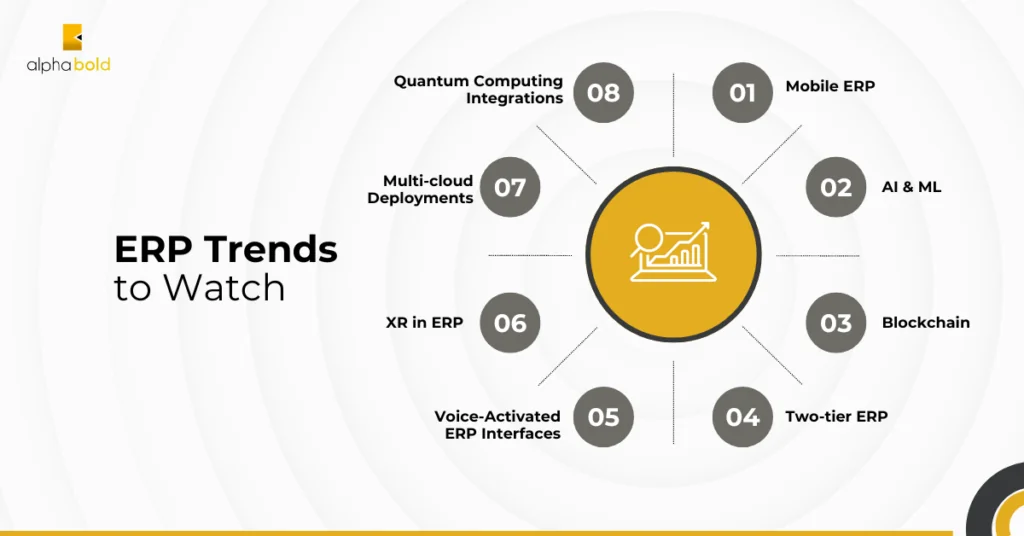
In this environment, CIOs and other C-level executives are not just technology consumers. They are strategic creators and optimizers who shape how ERP systems support innovation, compliance, and growth. By embracing ERP trends in 2026 such as AI, machine learning, mobile-first ERP, blockchain, two-tier ERP, and extended reality, executives can equip their organizations with the flexibility and intelligence needed to streamline processes and drive measurable value.
For readers looking to understand the fundamentals before diving into the trends, we recommend this “Understanding ERP: What is ERP and How Does It Work?”

ERP Selection Checklist
Download our free ERP Software Selection checklist and confidently navigate your journey to the perfect fit.
Learn More
ERP Technology Trends to Watch In 2026
1. AI & Autonomous ERP Agents:
Artificial intelligence is reshaping ERP from a transactional system into an intelligent decision-making engine. In ERP trends in 2026, one of the most significant shifts is the rise of autonomous ERP agents. These are AI-driven modules that can analyze data, execute workflows, and recommend or even carry out actions with minimal human intervention.
These capabilities go far beyond basic automation. AI now supports:
Predictive forecasting that accounts for multiple business drivers, such as supply chain risks, market demand, and financial patterns.
Generative AI copilots that assist users with tasks like report writing, journal entry analysis, or budget recommendations.
Anomaly detection that identifies irregularities in financial closes, operational bottlenecks, or compliance risks before they escalate.
ERP vendors are embedding these tools directly into their platforms. For example, NetSuite’s 2025.2 release introduced multivariate forecasting, AI-powered close management, and conversational quoting features. These updates are early signals of how deeply AI will be integrated into ERP by 2026.
What this means for leaders: AI is no longer an optional feature. It is becoming the default operating model of ERP, which means executives must prioritize governance, transparency, and training to build trust and ensure successful adoption across the enterprise.
2. Composable and Modular ERP Architectures:
A key theme in ERP trends in 2026 is the movement away from rigid, monolithic platforms toward composable and modular architectures. Instead of relying on one large system that is difficult to customize and upgrade, organizations are now assembling ERP environments from smaller, interoperable modules that can be scaled or replaced independently.
This modular approach delivers several benefits:
Flexibility: Enterprises can adopt only the components they need, reducing cost and implementation complexity.
Faster upgrades: Smaller, independent modules allow businesses to update specific capabilities without disrupting the entire ERP environment.
Integration power: Composable ERP enables smoother connections with CRM, supply chain, HR, and industry-specific applications.
Vendors are actively supporting this shift. NetSuite, for example, provides a wide range of SuiteApps and SuiteCloud extensions that allow customers to expand functionality without extensive custom development. As the ecosystem around ERP platforms grows, composable strategies will give businesses the ability to innovate without being tied down by traditional upgrade cycles.
What this means for leaders: CIOs and CTOs should assess whether their current ERP setup is flexible enough to evolve. Composable ERP architectures will become essential for keeping pace with new technologies and adapting to shifting business requirements.
3. Cloud-First, Multi-Cloud, and Two-Tier ERP Models:
Cloud adoption continues to be one of the strongest ERP trends in 2026. Most enterprises now operate in cloud or hybrid environments, and many are extending into multi-cloud and two-tier ERP strategies to balance flexibility, compliance, and cost.
- Cloud-first deployment: Cloud ERP is now the default choice for new implementations, offering automatic updates, faster scalability, and lower infrastructure overhead.
- Multi-cloud strategy: Companies are distributing ERP workloads across multiple providers to improve resilience, reduce dependency on a single vendor, and optimize for performance or regulatory requirements.
- Two-tier ERP: Enterprises with global operations are adopting a two-tier approach where headquarters run a large-scale ERP, while subsidiaries or regional offices deploy a lighter cloud ERP for local compliance and agility. NetSuite has become a leading option for second-tier deployments due to its flexibility and rapid rollout capabilities.
This shift reflects a broader push toward resilience and business continuity. By spreading ERP deployments across different clouds and tiers, organizations are better prepared to withstand disruptions, whether regulatory, technical, or market-driven.
What this means for leaders: Enterprises should re-evaluate whether their ERP strategy supports global-local balance, disaster recovery, and regional compliance. Cloud-first and two-tier ERP models will be central to delivering scalability without sacrificing control.
To better clarify two-tier ERP systems, read this detailed resource that will walk you through every detail of the system and how it can benefit your business, “Two-Tier ERP a New Approach to Streamlining Global Business Operations.”
4. Real-Time Analytics and Digital Twins:
Data-driven decision-making is becoming a core expectation in ERP trends in 2026. Enterprises are moving beyond static dashboards toward real-time analytics and digital twin capabilities that simulate and optimize business operations.
- Real-time analytics: Modern ERP systems now deliver instant insights into performance across finance, supply chain, and operations. Executives can see deviations as they happen and respond proactively rather than relying on historical reports.
- Digital twins: These virtual models replicate supply chains, production lines, or financial processes, enabling leaders to run “what-if” scenarios and evaluate the impact of different strategies before acting. This reduces risk and supports more confident planning.
- Predictive and prescriptive insights: ERPs are evolving from simply describing what happened to recommending actions that improve efficiency or profitability.
NetSuite’s latest contextual insights in SuiteAnalytics illustrate how ERP vendors are beginning to embed predictive and prescriptive intelligence into their platforms. As digital twin technology matures, enterprises will increasingly rely on ERP to test decisions virtually before deploying them in real operations.
What this means for leaders: The ability to simulate outcomes in real time transforms ERP from a reporting tool into a strategic advisor. Organizations that adopt digital twins and advanced analytics early will gain a significant edge in planning and operational agility.
5. Mobile and Conversational ERP Interfaces:
Accessibility and ease of use are central to ERP trends in 2026. As workforces become more distributed, mobile-first and conversational interfaces are transforming how employees and executives interact with ERP systems.
- Mobile ERP: Employees now expect to access ERP data and workflows on the go. From warehouse teams updating inventory in real time to managers approving purchase orders from their phones, mobile ERP is no longer optional.
- Conversational interfaces: Natural language processing enables users to interact with ERP systems through chat or voice commands. For example, Oracle has introduced conversational quoting in NetSuite, allowing users to generate quotes by simply describing requirements.
- User adoption benefits: Conversational and mobile-first ERP interfaces reduce training barriers, improve engagement, and help executives access insights instantly.
This shift reflects a broader demand for ERP systems that match the accessibility of consumer applications. Employees are more likely to engage with ERP when it feels intuitive and integrated into their daily workflows.
What this means for leaders: Investing in mobile ERP and conversational interfaces improves adoption and productivity across the enterprise. By 2026, organizations that fail to modernize ERP access may see lower engagement and missed opportunities for efficiency.
6. Blockchain for Secure, Transparent Transactions:
Security and trust remain top priorities in ERP trends in 2026, and blockchain is playing a growing role in addressing these challenges. By integrating decentralized ledger technology, ERP systems can provide greater transparency, traceability, and protection against tampering.
Data integrity: Blockchain creates tamper-proof records of transactions, ensuring that sensitive data such as financial records and supply chain logs cannot be altered without detection.
Smart contracts: Self-executing agreements built on blockchain automate tasks like supplier payments or compliance checks, reducing delays and eliminating manual intervention.
Regulatory alignment: Industries with strict compliance needs, such as healthcare, finance, and manufacturing, are exploring blockchain within ERP to meet audit and reporting standards more effectively.
While adoption is still selective and often industry-specific, blockchain is becoming an increasingly important capability in ERP strategies. It enhances trust in the data companies rely on for decision-making and creates a secure foundation for digital transactions.
What this means for leaders: Blockchain should be viewed as an enabler of ERP resilience rather than a standalone innovation. Leaders should evaluate whether their industry and compliance environment make blockchain integration a strategic advantage.
7. Embedded Sustainability and ESG Metrics:
The conversation around sustainability began years ago with early corporate social responsibility initiatives, but in 2026 it is more relevant than ever. What started as voluntary reporting has evolved into a core business requirement, with investors, regulators, and customers demanding greater accountability. ERP systems are now at the center of this shift, embedding ESG (Environmental, Social, and Governance) metrics as standard capabilities rather than optional add-ons.
Unified tracking across domains: Modern ERPs consolidate energy use, emissions, waste, supplier practices, and operational data in one platform.
Regulatory alignment and reporting: Stricter disclosure requirements are pushing enterprises to make ESG reporting audit-ready. According to Forbes, 96% of the world’s largest 250 companies already publish sustainability reports, a signal that ESG is no longer peripheral but central to business performance.
Decision support and optimization: By integrating ESG with financial and operational data, executives can make trade-offs between cost, carbon impact, and compliance more effectively.
Sustainability-driven innovation: Companies are using ERP to model product life cycles, track material reuse, and evaluate carbon-reduction strategies across their operations.
What this means for leaders: By 2026, ESG data will sit alongside revenue and cost on executive dashboards. Organizations that do not embed sustainability into ERP risk being unprepared for regulation, falling short of stakeholder expectations, and losing competitive ground.
Interested in a Demo for Cloud ERP Solution like NetSuite?
Are you ready to boost your business operations through efficient ERP solutions? Allow AlphaBOLD to lead you through a smooth ERP implementation journey tailored to your success.
Request a Demo8. Future Watch: Extended Reality and Quantum Computing:
Some technologies are not yet mainstream in ERP but are advancing quickly enough to warrant executive attention. In ERP trends in 2026, extended reality (XR) and quantum computing remain in the early stages, yet their potential impact on ERP is significant.
Extended Reality (XR): Augmented reality (AR) and virtual reality (VR) are being piloted in ERP for use cases such as immersive training, interactive data visualization, and factory floor maintenance. AR can overlay real-time inventory or workflow data onto physical environments, while VR provides simulated spaces for planning and design. Adoption is still limited, but early pilots suggest value in manufacturing, construction, and field service industries.
Quantum Computing: Though still experimental, quantum computing could eventually transform ERP performance by enabling advanced simulations, complex resource optimization, and real-time predictive analytics on massive datasets. For now, most use cases are confined to research and industry pilots, but progress indicates ERP vendors are preparing to leverage this technology in specialized areas.
What this means for leaders: XR and quantum computing should not be immediate priorities, but they deserve a place on the radar. Enterprises that monitor developments and test early use cases will be better prepared to take advantage of these capabilities when they mature into practical ERP applications.
AlphaBOLD Expertise in ERP Consultation & Implementation
AlphaBOLD has years of ERP implementation experience that helps companies align different processes in one robust system. Our experts have worked with companies of all sizes and industries to implement tailored ERP solutions successfully. We are fully equipped to deliver advanced ERP and business solutions on agility and scalability. We ensure that our recommendations meet your business needs regardless of your company’s size.
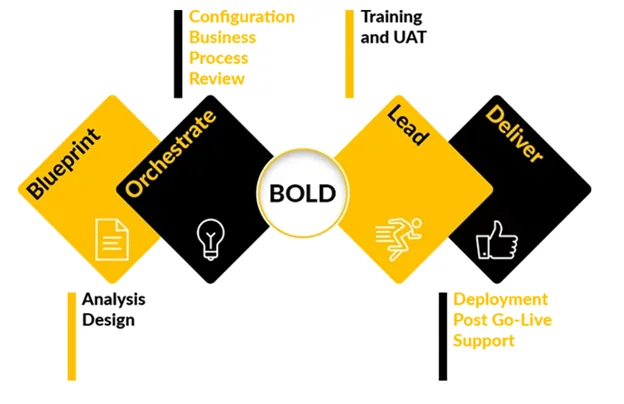
For more information, read “A Guide to NetSuite Implementation: The Importance of Configuration Sequence.”
Innovate and Grow with AlphaBOLD's ERP Implementation
AlphaBOLD's ERP implementation services are designed to help you innovate, expand, and reach your operational objectives.
Request a DemoConclusion
ERP systems are entering a new era in 2026. What began as back-office automation is now evolving into an intelligent, adaptable ecosystem that influences every part of the enterprise. From AI-driven agents and composable architectures to multi-cloud strategies, real-time analytics, and embedded ESG, ERP is becoming central to resilience and growth.
For CIOs, CTOs, and business leaders, the priority is clear: identify which ERP trends in 2026 align with your strategic goals and act before they become industry standards. Organizations that modernize early will be positioned to operate with greater efficiency, stronger compliance, and sharper decision-making.
Explore Recent Blog Posts