NetSuite vs. Campfire: 2027 Buyer’s Guide to Cost, Time-to-Value, and Re-Platforming Risk

Table of Contents

NetSuite vs. Campfire is not simply a choice between an established ERP and a newer AI-native platform. The bigger question is how much of your business the ERP needs to run. Campfire can be compelling for finance-focused, asset-light companies seeking faster implementation. NetSuite becomes a stronger candidate when finance needs to operate alongside inventory, orders, warehousing, manufacturing, supply chain, or other operational processes.

For businesses planning an ERP investment in 2027, that difference affects more than the feature list. It affects implementation cost, time-to-value, the number of systems you may need around the ERP, and the likelihood that you will eventually need another major platform change.

This guide compares NetSuite and Campfire through those buyer considerations.

What Is the Biggest Difference Between NetSuite and Campfire?

Campfire and NetSuite overlap significantly in financial management, but they approach ERP from different starting points.

Campfire is a newer finance-first ERP designed around accounting workflows such as financial close, consolidation, revenue recognition, reconciliation, reporting, and multi-entity financial management. It has gained particular attention among SaaS, technology, professional services, and other asset-light businesses.

NetSuite is a broader cloud ERP. Financial management sits alongside operational functions including inventory, procurement, order management, supply chain, warehouse operations, projects, and production. NetSuite describes the platform as an integrated suite covering accounting, orders, inventory, projects, production, supply chain, and warehouse operations.

For a closer look at the broader platform, see NetSuite ERP solutions from AlphaBOLD.

This distinction matters because the scope of the ERP determines how useful a simple price or implementation-timeline comparison really is.

A SaaS company that needs better financial close, revenue recognition, reporting, and multi-entity consolidation is solving a different problem from a distributor that also needs purchasing, stock visibility, order fulfillment, warehouse processes, and ecommerce integration.

The platforms should therefore be compared against the processes the organization actually expects its ERP to own.

That approach aligns with Gartner’s guidance for finance ERP selection. Gartner recommends that CFOs actively lead the vendor-selection process and prioritize strategic alignment and process resilience rather than treating ERP selection as a basic technology procurement exercise.

NetSuite vs. Campfire at a Glance

Decision area Campfire NetSuite

Core financial management

Strong focus

Strong
Multi-entity accounting
Yes
Yes
Multi-currency
Yes
Yes
Revenue recognition
Major product focus
Available
Financial close automation
Major product focus
Available and expanding
AI-assisted finance
Central to product positioning
Increasingly embedded across NetSuite
Inventory management
Not a primary platform focus
Extensive
Order management
Not a primary platform focus
Extensive
Warehouse management
Not a primary platform focus
Available
Manufacturing
Not a primary platform focus
Available
Supply chain
Limited compared with full operational ERP
Extensive
Implementation model
Campfire says typically 8–12 weeks
Depends heavily on scope and complexity
Pricing
Quote-based
Quote-based
Product maturity
Newer platform
Mature ERP ecosystem
Strongest fit
Finance-led, asset-light organizations
Businesses combining finance with broader operations

The important point is not that one column contains more capabilities. More functionality does not automatically make an ERP a better purchase. The question is whether those capabilities belong inside your ERP boundary.

Which Platform Costs Less to Implement and Own?

There is no reliable universal answer to “Is Campfire cheaper than NetSuite?”

Neither company publishes enough standardized pricing to calculate a meaningful head-to-head total cost for every buyer.

Campfire states that its pricing depends on factors such as organizational complexity and promotes implementation as part of its commercial model. Its current NetSuite comparison also advertises an 8–12-week implementation timeline. These are Campfire’s own vendor claims and should be evaluated against the scope of the proposed project.

NetSuite also varies substantially.

Based on projects AlphaBOLD has scoped and delivered, current planning ranges for NetSuite implementation are approximately:

  • Small businesses: $15,000–$55,000
  • Mid-market organizations: $50,000–$120,000
  • Complex enterprise environments: $130,000–$350,000+

Annual licensing can add roughly $25,000–$50,000 at the smaller end, $75,000–$200,000 for many mid-market environments, and $200,000–$500,000+ for larger, more complex requirements. These are broad planning ranges, not quotes. Actual cost depends on modules, users, integrations, implementation complexity, and other requirements.

Businesses evaluating NetSuite can estimate NetSuite licensing and implementation costs using AlphaBOLD’s pricing calculator. For a deeper breakdown of licensing, migration, customization, training, implementation, and ownership costs, see the NetSuite Implementation Pricing Guide and Cost of Ownership.

Do not compare ERP prices until you compare ERP boundaries:

A useful TCO comparison should include at least five cost areas:

1. Software costs

What are the subscription, module, user, usage, and renewal costs? 

2. Implementation costs

What does it take to configure the platform, migrate historical data, establish roles and permissions, test processes, train users, and go live?

3. Integration and administration costs

What systems need to connect with the ERP, and how much internal or partner support will the environment require after launch?

4. Adjacent system costs

What requirements remain outside the ERP?

This becomes particularly important when comparing an accounting-focused platform with a broader operational ERP. A company that needs inventory, warehouse, production, advanced order management, or other operational capabilities may need to account for additional platforms and integrations if those functions are not handled inside its finance ERP.

5. Future replacement costs

How likely is the business to require another ERP migration within three to five years?

That final category is often missing from ERP comparisons.

See What NetSuite Would Cost for Your Business

NetSuite pricing and implementation effort depend on your users, modules, integrations, data, and operational requirements. Talk to AlphaBOLD about your current setup and see what a realistic NetSuite implementation could look like for your business.

Request a NetSuite Demo

Which ERP Gets to Value Faster?

Campfire has made implementation speed one of its major competitive messages.

Its current website states that customers can go live in approximately 8–12 weeks, while another Campfire comparison resource refers to 4–8 weeks.

Those numbers should be treated as vendor-reported timelines rather than universal implementation benchmarks.

NetSuite implementations can take longer because projects may include significantly broader scope.

A finance-only NetSuite project with straightforward data and limited integrations is fundamentally different from an implementation covering financials, inventory, warehouse management, procurement, manufacturing, multiple subsidiaries, and ecommerce.

That leads to an important distinction:

Time-to-go-live is not always the same as time-to-equivalent-value.

Suppose Company A needs:

  • general ledger;
  • accounts payable and receivable;
  • consolidation;
  • revenue recognition;
  • reporting;
  • financial close.

A finance-focused ERP may get that organization to its required end state relatively quickly.

Company B needs those same financial processes plus:

  • inventory;
  • purchasing;
  • order management;
  • warehouse operations;
  • fulfillment;
  • manufacturing;
  • ecommerce.

If a narrower finance ERP goes live faster but requires several additional systems and integrations to deliver the same operating model, comparing the two ERP deployment dates in isolation is not particularly useful.

The opposite is also true.

A SaaS company with no inventory, warehousing, manufacturing, or complex supply-chain requirements does not receive additional value simply because an ERP contains those functions. Implementing more software than the company needs can increase project effort without improving the business case.

Before accepting any implementation estimate, buyers should define the project scope, migration requirements, integrations, users, workflows, and expected outcomes. AlphaBOLD’s NetSuite implementation services cover the implementation process from discovery and data requirements through configuration and go-live.

Where Does Campfire Have an Advantage?

Campfire deserves serious consideration where financial operations are the primary ERP requirement.

Its strongest current proposition centers on accounting teams managing areas such as:

  • financial close;
  • reconciliations;
  • multi-entity accounting;
  • consolidation;
  • revenue recognition;
  • SaaS and recurring-revenue models;
  • financial reporting;
  • AI-assisted finance workflows.

It is also competing directly for dissatisfied NetSuite customers.

For example, Campfire’s published Advisor360 case study reports that the company moved from NetSuite to Campfire and reduced its closing from six days to three. The case study also reports more than eight hours per month saved on cash reconciliations. These are individual vendor-published customer results, not expected outcomes for every implementation, but they demonstrate the type of finance-heavy use case Campfire is pursuing.

Campfire has even established a $5 million “CFO Buyout Fund” intended to help some customers cover existing ERP contract commitments when moving from platforms such as NetSuite, Sage, or SAP.

This matters because buyers should not dismiss Campfire simply because it is newer.

If your ERP requirements are concentrated inside accounting and finance, its narrower focus can be an advantage rather than a limitation.

Where Does NetSuite Have an Advantage?

NetSuite becomes considerably more differentiated once ERP requirements extend into operational processes.Oracle describes NetSuite ERP as a unified platform spanning accounting, orders, inventory, projects, production, supply chain, and warehouse operations.

For organizations handling physical products, NetSuite can manage inventory across locations, replenishment, safety stock, order processing, purchasing, and related workflows.

Its warehouse-management capabilities include mobile barcode scanning, putaway and picking strategies, cycle counts, and task management. Because WMS sits within the wider NetSuite suite, warehouse information can operate alongside inventory, fulfillment, manufacturing, and financial data.

NetSuite also supports manufacturing functions such as bills of materials, work orders, assembly builds, production tracking, and related costing.

The difference therefore becomes particularly relevant for:

  • distributors;
  • manufacturers;
  • retailers;
  • ecommerce businesses;
  • product companies;
  • organizations managing warehouses;
  • companies with complex procurement and fulfillment processes.

Integrations still matter even when more functions sit inside the ERP. AlphaBOLD provides NetSuite integration services for systems including CRM, ecommerce, logistics, payments, WMS, and other applications.

Does Campfire Have an AI Advantage Over NetSuite?

Campfire was built in the current generation of AI-led business software, and AI-assisted accounting is central to how it positions the platform. But that does not automatically give it an advantage over NetSuite.

NetSuite has been expanding AI across a much broader ERP environment that already connects financial and operational processes. NetSuite 2026.2 is bringing Ask Oracle into the platform while continuing the rollout of NetSuite Next. Oracle says Ask Oracle can work with business data using natural language, generate reports, surface insights, navigate records, and support everyday tasks. The same release includes AI-assisted transaction matching and Intelligent Flux Analysis for finance teams.

You can explore the current functionality in AlphaBOLD’s guide to NetSuite Ask Oracle.

That broader ERP context is where NetSuite has an important advantage. AI can work across financial data alongside areas such as inventory, orders, procurement, projects, and other operational processes, depending on the NetSuite environment in use.

Campfire may offer a more AI-native finance experience, but NetSuite gives businesses the opportunity to apply AI across a wider set of connected business processes.

For buyers, the better question is therefore:

Which platform can apply AI across the processes and data our business actually needs the ERP to manage?

When Does Re-Platforming Risk Matter More Than Year-One Cost?

An ERP can look cheaper in Year 1 and still become the more expensive decision over five years.

That is where re-platforming risk becomes important.

Re-platforming risk is the likelihood that the ERP you select today will stop matching the scope of the business during your planning horizon, forcing you either to add major systems around it or replace it.

Consider a software company that currently needs only:

  • accounting; 
  • revenue recognition;
  • close;
  • consolidation;
  • reporting.

Campfire may fit that requirement well.

But suppose the company’s business model changes over the following four years. It begins selling physical equipment alongside subscriptions, opens distribution locations, carries inventory, and develops a more complex procurement operation.

The original ERP decision may now need to be reconsidered.

That does not mean the earlier Campfire decision was wrong. It means the company should have included its expected operating model in the original evaluation.

The same logic applies in the opposite direction.

A 70-person SaaS company may purchase NetSuite because it offers considerably broader capabilities, only to use a small percentage of them. If the organization has limited operational complexity, it may absorb additional implementation effort and administration without receiving enough value in return.

So re-platforming risk should be evaluated alongside overbuying risk.

Before choosing either ERP, model what the organization could realistically require over the next three to five years.

Ask whether you expect to:

  • carry significant inventory;
  • open warehouses;
  • manufacture products;
  • add legal entities or subsidiaries;
  • expand into additional countries;
  • introduce ecommerce;
  • add complex procurement;
  • manage fulfillment inside the ERP;
  • introduce new revenue models;
  • acquire businesses with different systems;
  • materially increase integration requirements.

The answers make the platform comparison much more useful.

Which Businesses Are Better Fits for Campfire vs. NetSuite?

There is no reliable employee-count threshold where a company suddenly becomes a NetSuite business rather than a Campfire business.

Operational complexity is a better filter.

Business scenario Likely stronger shortlist

Core financial management

Campfire deserves strong consideration

Technology company focused on finance, consolidation, and close
Campfire or NetSuite
Multi-entity professional services company
Both, depending on project/service requirements
Wholesale distributor
NetSuite
Manufacturer
NetSuite
Ecommerce business carrying significant inventory
NetSuite
Company managing warehouses and fulfillment
NetSuite
Finance-led company prioritizing a fast deployment
Campfire deserves consideration
Company expecting physical operations within several years
NetSuite deserves stronger consideration
Organization needing finance plus broad operational processes in one ERP
NetSuite

This is why a feature spreadsheet alone rarely settles the decision.

The platform with fewer features may fit a narrowly defined requirement better. The platform with broader capabilities may offer a better economic case when those capabilities replace other systems or prevent a future migration.

AlphaBOLD’s broader software selection guide recommends starting with business outcomes, workflows, integrations, technical constraints, ownership costs, and future requirements before scoring vendors. 

Compare NetSuite Against Your Actual Business Requirements

If you are weighing NetSuite against Campfire, the right answer depends on what your ERP needs to support now and over the next few years. AlphaBOLD can help you assess your requirements, implementation scope, integrations, and expected costs before you commit to a platform.

Request a Demo

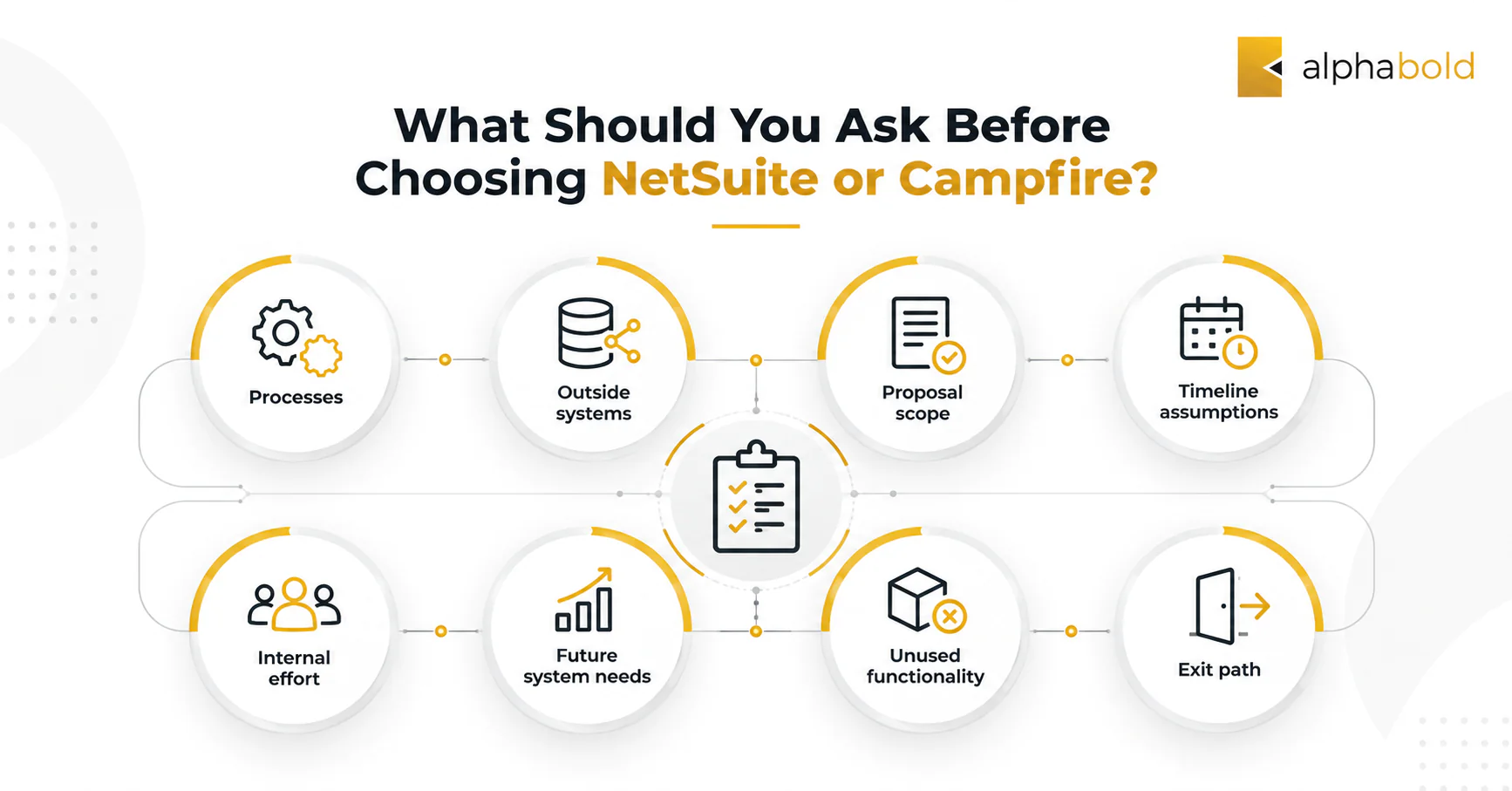
What Should You Ask Before Choosing NetSuite or Campfire?

Before making the final decision, ask both vendors the same set of questions.

ERP Evaluation Decision Checklist

1. Which business processes will the ERP own?

Define this before the demo. Separate finance, operations, customer processes, supply chain, reporting, and adjacent applications.

2. What remains outside the ERP?

Map every major system you will retain and determine how those platforms will exchange data with the new ERP.

3. What exactly is included in the commercial proposal?

Separate software, implementation, migration, integrations, training, support, modules, usage charges, and future additions.

4. What assumptions are behind the implementation timeline?

An eight-week deployment means little without knowing the entities, history, integrations, workflows, reporting requirements, and users included.

5. How much internal effort will implementation require?

Consider finance, IT, operations, leadership, testing, data cleanup, and user training.

6. What business requirements could force us to add another system later?

This is particularly important when evaluating a narrower ERP.

7. What functionality are we paying for that we are unlikely to use?

This is particularly important when evaluating a broader ERP.

8. What would it take to leave the platform?

Understand data extraction, contractual commitments, integrations, historical records, and migration requirements before you sign.

ERP selection becomes considerably clearer when vendors are evaluated against the same operating model rather than against their own preferred demonstration scripts.

NetSuite or Campfire: Which Should You Choose?

Campfire deserves consideration if the primary goal is modernizing financial operations, particularly for SaaS, technology, professional services, and other asset-light companies that value accounting automation and a comparatively focused ERP scope.

NetSuite becomes a stronger candidate when financial management must operate alongside inventory, order management, procurement, warehouses, production, supply chain, ecommerce, or other operational processes.

The deciding factor should not be which platform has the longest feature list or the shortest advertised implementation timeline.

It should be:

What does the ERP need to run, what will that complete operating model cost, and how likely are those requirements to change during the life of the platform?

Once those questions are answered, the NetSuite vs. Campfire decision becomes much easier to evaluate.

FAQs

Is Campfire cheaper than NetSuite?

It may be for some finance-focused implementations, but there is not enough standardized public pricing to say Campfire is universally cheaper. Campfire uses quote-based pricing and promotes implementation as part of its model. NetSuite cost varies significantly according to users, modules, integrations, migration requirements, and project complexity. Buyers should compare full ownership cost rather than subscription pricing alone.

Can Campfire replace NetSuite?

For some organizations, yes. Campfire already publishes customer examples of businesses that migrated from NetSuite. Whether it can replace NetSuite in a specific company depends on what NetSuite currently manages. A finance-focused deployment is very different from a NetSuite environment handling inventory, warehouses, manufacturing, order management, and other operational processes.

How much does NetSuite cost to implement?

AlphaBOLD’s current planning ranges put NetSuite implementation at approximately $15,000–$55,000 for smaller straightforward deployments, $50,000–$120,000 for many mid-market projects, and $130,000–$350,000+ for complex enterprise environments. Actual pricing depends on implementation scope, modules, integrations, data migration, users, and business complexity.

Explore Recent Blog Posts

270x330

Related Posts

Receive Updates on Youtube
Copyright © 2025 AlphaBOLD | NetSuite Solution Provider | All Rights Reserved | Privacy Policy