
Table of Contents
Introduction
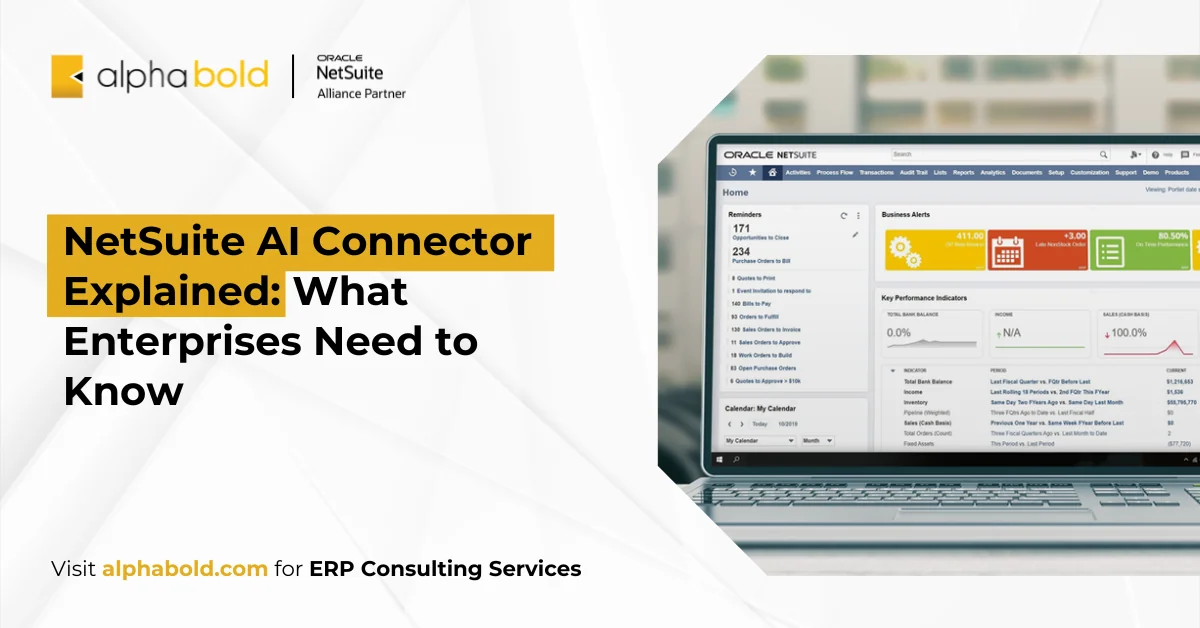
AI becoming a part of ERPs was inevitable, and businesses had foreseen it since the 2000s. Yes! This goes way back. It took this many years, but early integrations and automations laid the groundwork. Big ERPs like Dynamics 365 and NetSuite already ship AI-powered close management, cash forecasting, and reconciliation tools built into the platform.
This guide breaks down what’s changed across the major platforms, what each vendor has actually shipped, and what these AI-driven ERP workflows do in practice for finance and operations teams.
What Does AI-Driven ERP Actually Mean in 2027?
An AI-driven ERP workflow routes transactions, flags exceptions, and adjusts forecasts without requiring someone to open five different tabs. The system flags a supplier delay or a cash flow risk the moment the underlying data changes, rather than waiting for a monthly report.
This is entirely different from the automation ERPs have run for years. Older rule-based automation follows fixed logic: if a condition is met, run a set of actions. The AI agents now shipping within these platforms read context, weigh multiple signals, and route decisions to a person only when judgment is actually needed.
For a decision maker, the practical difference shows up in three places:
- Approvals move based on risk, not on who happens to be free to sign off.
- Exceptions arrive with a plain-language explanation attached, not just a red flag.
- Forecasts update as new data lands, instead of waiting for the next planning cycle.
What AI Features Are Major ERP Platforms Adding?
Major ERP and finance platforms have each taken their own approach to embedding AI.
- Microsoft Dynamics 365 runs Copilot for Finance and a role-based Finance Agent embedded in Excel, Outlook, and Teams. Its 2026 release wave added a Payflow Agent for automated payment processing and natural-language data access built on the Model Context Protocol.
- SAP built its AI assistant, Joule, across S/4HANA Cloud, SuccessFactors, and Ariba. Joule now translates e-invoicing errors into plain language, and SAP’s Dispute Resolution Agent automates root-cause analysis on invoice disputes.
- Oracle Fusion Cloud ERP, Oracle’s enterprise-tier platform, added Fusion Agentic Applications in 2026, including a Ledger Agent, Expenses Agent, Payables Agent, and Payments Agent built to run finance processes with less manual follow-up.
- Workday added a Financial Close Agent, a Cost and Profitability Agent, and a Financial Audit Agent to its Illuminate platform, aimed at speeding the close and strengthening controls across HR and finance.
Each platform has a solution for the same problem, but with a different architecture. All of them are trying to get AI close enough to the transactional data that it can actually act, not just suggest.
Every major ERP platform is shipping AI at a different pace
It's easy to lose track of what's actually production-ready versus still in preview. Connect with our ERP AI specialists for a clear read on what's live today across your stack
Connect with Our ExpertsWhat Changes First When AI Moves Into Core ERP Workflows?
First and foremost, the routine work changes. Transaction classification, approval routing, and exception handling shift from manual review to AI-assisted judgment. This frees finance and operations teams to spend time on the decisions that actually need a person.
- Automated transaction classification cuts manual data entry in finance and procurement.
- Predictive workflow routing sends approvals to the right person based on risk, not seniority.
- Exception handling explains anomalies in plain language instead of a raw error code.
- Continuous process monitoring flags slowdowns before they turn into a missed close date.
It doesn’t mean that these changes replace your finance or operations team. They remove the repetitive first pass, so your team can spend time on the decisions that move the business forward.
For a decision maker evaluating where to start, these four shifts are also the easiest to measure. Each one maps to a metric you likely already track: transaction volume, approval cycle time, exception count, and process cycle time.
What Does the Data Say About AI-Driven ERP Performance in 2027?
We know that to help you build trust, we need to share some performance data to back up our claims. Here are some current stats:
- Only about 40% of companies report any enterprise-level EBIT impact from their AI initiatives, even though roughly 80% of companies already use generative AI in at least one business function, according to McKinsey. That gap between adoption and impact is exactly what shows up when AI sits alongside the ERP rather than inside it.
- Gartner predicts that finance organizations running cloud ERP with embedded AI assistants will see a 30% faster financial close by 2028.
- Companies applying AI broadly across products, services, and customer experience achieved close to four percentage points higher profit margins than companies that didn’t, and CEOs with strong AI foundations already in place were three times more likely to report meaningful financial returns.
- Nearly 70% of S&P 500 companies that mentioned AI on their Q1 earnings calls cited automation, optimization, or efficiency use cases.
The pattern is pointing in the same direction. AI pays off in ERP workflows when it’s built into the system that runs the business.
How Should Decision Makers Evaluate AI-Driven ERP Workflows in 2027?
As AI has now been built into every major ERP platform, the question for most decision-makers is: which features are already live in their accounts and worth turning on first? So, what do you need to do before investing more in the ERP of your choice in 2027?
- Start with one workflow that has a measurable outcome, like close time or exception volume, and build from there.
- Check what’s already included in your current license before buying a separate AI add-on. Features like NetSuite’s Text Enhance ship with standard editions, while others, like Bill Capture and Planning and Budgeting, are separately licensed.
- Assign a single owner for rollout and results, not a committee. Accountability moves adoption past a pilot.
- Track EBIT or cost impact from day one instead of adoption metrics like logins or usage rates.
The point to note here is that most of the AI capabilities decision makers are looking for in 2027 are already built into the platform they’re running today.
Conclusion
AI-driven ERP workflows are unavoidable. NetSuite, Dynamics 365, SAP, Oracle Fusion Cloud, and Workday have all shipped meaningful AI capability directly into their core platforms. The data we have quoted above shows what happens when companies actually use it.
Every major ERP platform is shipping AI at a different pace
Deciding which AI-driven ERP workflow to tackle first shouldn't be a guessing game. Request a consultation with AlphaBOLD and leave with a clear roadmap for the AI capabilities that will actually move your close time, cash visibility, and margin.
Request a ConsultationFAQs
Which ERP platforms have the most AI built in right now?
NetSuite, Microsoft Dynamics 365, SAP S/4HANA Cloud, Oracle Fusion Cloud, and Workday have all shipped native AI agents or assistants as of 2026. The specific features vary by platform, module, and licensing tier.
Do I need to replace my current ERP to add AI capabilities?
No. Platforms like NetSuite integrate AI features directly into existing modules through regular releases, enabling most organizations to implement AI-driven workflows without a full system migration.
How do I know if my ERP data is ready for AI?
Check whether your core transaction data is clean, consistently categorized, and accessible through an API before adding AI on top of it. AI built on inconsistent data produces answers that look confident but are wrong.
Should finance or IT own the AI rollout?
Neither should own it alone. Whoever is accountable for close time, forecast accuracy, or procurement cycle time needs to drive the initiative, with IT and AI specialists supporting execution.