Table of Contents
Introduction
Most companies using NetSuite face a coverage issue rather than a software problem. Typically, a single administrator manages the entire system, causing tickets to accumulate over several days. Any customizations or integrations are dependent on that individual’s availability, leading to delays when they are unavailable or leave the company.
This results in delayed support and increased backlogs. NetSuite managed services resolve this by providing a team of specialists dedicated to your instance, rather than relying on one internal employee. This guide explains what managed services include, compares their costs to building an in-house team, offers tips for selecting a provider, and discusses the benefits companies experience after making the switch.
What Is NetSuite Managed Services?
NetSuite managed services provide continuous support, maintenance, and optimization of your NetSuite system through a dedicated external team. This team offers expertise across various modules, releases, and integrations, eliminating the need for you to hire, train, and retain staff internally.
A typical engagement covers:
- Day-to-day ticket resolution and end-user support
- NetSuite release testing and update management
- Customization and SuiteScript maintenance
- Integration monitoring for third-party apps, EDI, and e-commerce connections
- Performance tuning and system health checks
- Ongoing optimization and roadmap planning
You may also like: 10 Signs Your NetSuite ERP Needs Optimization Now.
Why Are Companies Moving Away From In-House-Only NetSuite Support?
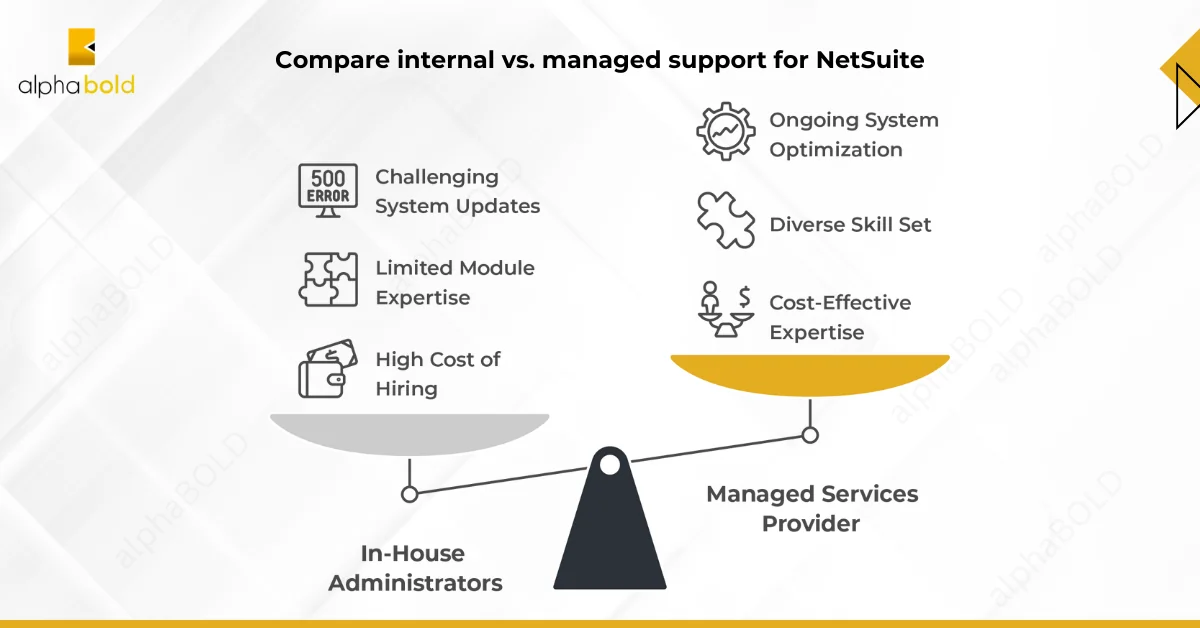
Companies are adopting managed services because a single internal admin or a small team cannot typically handle all modules, releases, and integrations without leaving gaps. Three common issues tend to arise repeatedly.
Can One In-House Admin Cover Every NetSuite Module?
Rarely. NetSuite spans financials, inventory, CRM, e-commerce, and a growing library of third-party SuiteApps, and expecting one person, or a two-person team, to stay current on all of it while also handling daily tickets isn’t realistic. Add in employee turnover, and business continuity depends on whoever is left holding the knowledge.
Why Does NetSuite's Own Support Fall Short for Custom Needs?
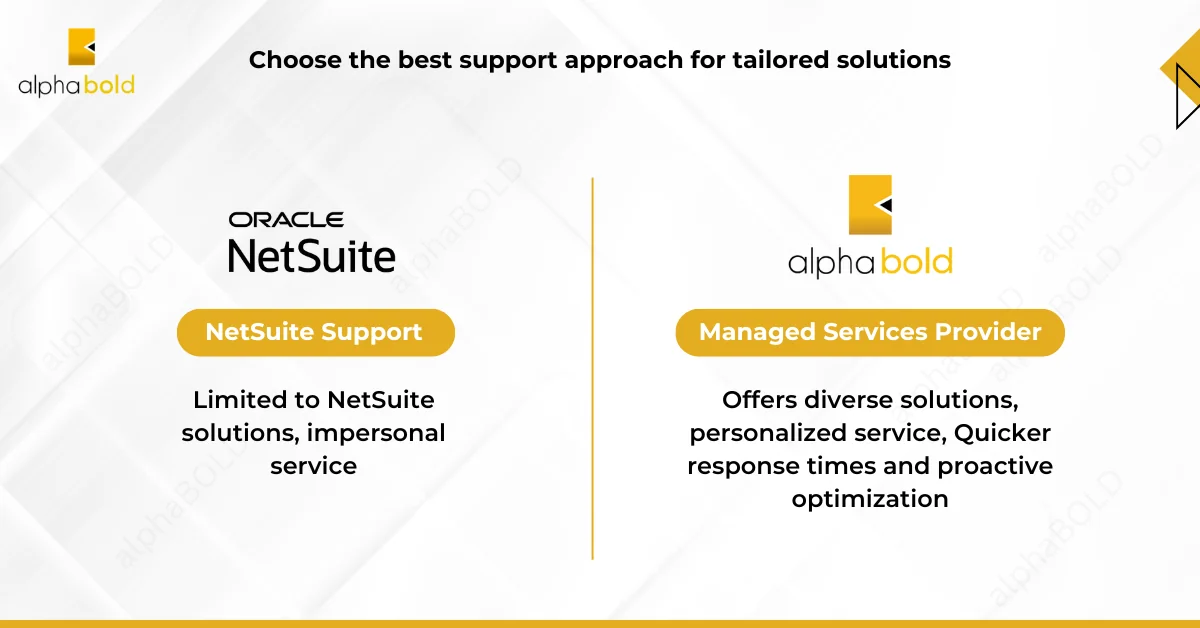
NetSuite’s support team knows NetSuite’s own products well, but their scope stops there. They won’t recommend third-party tools outside certified SuiteApps, even when an external solution better fits your industry. Support tickets also route through different reps each time, so there’s no continuity and no one who knows your specific setup.
How Does Managed Services Pricing Compare to Hiring In-House?
Most managed services run on subscription or time-and-material pricing, so costs stay predictable month to month. Compare that to an internal hire: salary, benefits, training, ramp-up time, and the risk of that person leaving in year two. A managed services team also scales up or down as your NetSuite footprint grows, without a new hiring cycle.
Still patching NetSuite support together with one internal hire?
Get a clear roadmap of what a dedicated NetSuite team would cost.
Request a ConsultationWhat Results Do Companies See After Switching to Managed Services?
Companies often experience a quicker turnaround and free up internal staff for more strategic tasks within just a few months. For example, a mid-sized software firm in San Francisco hired a NetSuite managed services provider to handle tasks that previously occupied one and a half Finance and IT staff members.
As a result, the turnaround gets cut in half. The Finance IT team then diverted the saved time to creating a data lake, assessing AI solutions, and enhancing system performance, rather than focusing on support queue tasks.

How Do You Choose the Right NetSuite Managed Services Provider?
Pick a provider with a direct NetSuite relationship, a track record you can verify, and a contract that spells out response times before you sign. Three checks matter most.
- Work with NetSuite Alliance Partners and Solution Providers. These partners have an established relationship with NetSuite and direct access to NetSuite resources when issues need escalation.
- Interview the actual consultants, not just the sales team. You’re not hiring one person, but the consultants you’ll work with reflect the vendor’s real expertise.
- Review the Service Level Agreement line by line. Confirm support hours, case limits, and guaranteed response times in writing so mission-critical issues have a defined turnaround, not a best guess.
You may also like: Maximizing NetSuite Through Customizations: A User’s Guide

Why Work With AlphaBOLD for NetSuite Managed Services?
AlphaBOLD runs NetSuite managed services alongside implementation, customization, and integration work, so the same team that knows your instance can also extend it as your needs change. That means fewer handoffs between support and project work, and a single point of contact who already knows your setup, rather than a new rep on every ticket.
Ready to stop losing time to a support backlog?
Talk to an AlphaBOLD NetSuite consultant about coverage, pricing, and a transition plan built around your instance.
Request a ConsultationConclusion
NetSuite managed services turn fragmented, single-person support into a team that covers every module, patch, and integration connected to it. Support gaps close once that coverage doesn’t depend on one person’s calendar or a support ticket landing with a new rep every time.
Choose a provider with a direct NetSuite relationship, a clear SLA, and a verifiable track record, and the investment pays for itself through fewer stalled tickets and more time back for your internal team.
AlphaBOLD backs that coverage with a full NetSuite team, not a single point of failure. Talk to us about what a managed services plan would look like for your instance.
Frequently Asked Questions
How much do NetSuite managed services cost?
Most providers price it as a monthly subscription or a time-and-materials rate based on ticket volume and scope, rather than a flat industry number. Expect the quote to scale with your instance size and the number of modules and integrations it covers.
Are NetSuite managed services only for companies without an internal admin?
No. Many companies keep one internal admin for day-to-day business decisions and add a managed services team for module depth, overflow support, and coverage when that admin is out.
What’s the difference between NetSuite’s own support and a managed services provider?
NetSuite’s support team can only recommend NetSuite’s own certified solutions and rotates reps between tickets. A managed services provider stays with your account, can recommend third-party tools when they are a better fit, and handles your specific customizations directly.
Can a managed services team handle SuiteScript and custom workflows?
Yes, provided the provider has SuiteScript developers on staff, not just functional consultants. Ask about this directly during vendor selection since not every managed services offering includes development coverage.
Explore Recent Blog Posts