19 March, 2025

Shopify Integration with NetSuite: Methods, Costs and How to Choose

Table of Contents

Quick Answer

Shopify integration with NetSuite connects your storefront and ERP so orders, inventory, fulfillments, and refunds move between the two systems without manual data entry. The main options are Oracle’s NetSuite Connector, an iPaaS platform, a third-party connector app, or a custom build to connect these two systems.

Introduction

When Shopify and NetSuite are not properly connected, the same transaction gets handled more than once. Orders reach NetSuite late or with mismatched discount and tax lines; the storefront shows stock the warehouse has already allocated; and finance matches Shopify payouts to NetSuite deposits by hand at month-end. Many teams already have an integration, yet it was often set up for a single B2C store and has not kept pace with B2B accounts, POS locations, or new channels.

What Are the Ways to Integrate Shopify with NetSuite?

There are four practical methods: Oracle’s NetSuite Connector, an iPaaS platform, a third-party connector app, and a custom-built integration. Manual CSV imports also exist but are only suitable for very low order volumes as a short-term measure.

What Does the NetSuite Connector for Shopify Cover?

The NetSuite Connector is Oracle’s pre-built integration, originally developed as FarApp, and it supports Shopify B2C and B2B storefronts as well as Shopify POS. Its standard flows include:

  • Products, pricing, and inventory: Item data is managed in NetSuite and sent to Shopify, which helps keep the storefront aligned with operational records.
  • Orders and customers: Shopify orders and customer records are imported into NetSuite, which reduces manual order entry.
  • Fulfillments: Fulfillment status updated in NetSuite is sent back to Shopify so that shipping updates can reach customers.
  • B2B orders and payments: The B2B connector syncs B2B orders separately from B2C orders, syncs company customers, and can send payments recorded in NetSuite back to Shopify to mark invoices as paid.

Refunds need planning. The connector syncs refunds in one direction per Shopify account, and Oracle recommends processing Shopify refunds in NetSuite and syncing them to the storefront.

When Do iPaaS, Third-Party Apps or Custom Builds Make Sense:

An iPaaS platform such as Celigo, Boomi, or MuleSoft is a good fit when Shopify is one of several systems connected to NetSuite, such as a 3PL, marketplace, or payment provider. These platforms provide prebuilt templates, monitoring, and error handling in one place, and Celigo offers a Shopify Markets edition that can sync records in local currency. The trade-off is a higher subscription cost and the need for someone to own the flows.

Third-party apps cover common flows at a lower entry cost, though support and update frequency vary by vendor. A custom build gives full control over mapping and logic but needs developers who know both platforms. New builds should use Shopify’s GraphQL Admin API and NetSuite’s REST web services, for reasons covered below.

How Do the Shopify NetSuite Integration Methods Compare?

Each method trades setup effort against flexibility and long-term ownership.

Method Best fit Strengths Limitations

NetSuite Connector

Shopify B2C, B2B, or POS with standard flows

Supported by Oracle, prebuilt Shopify flows

Limited custom logic; one-way refund sync per account

iPaaS (Celigo, Boomi, MuleSoft)

Several systems connected to NetSuite

Central monitoring, reusable flows

Higher subscription cost; needs an owner

Focused needs at moderate volume

Focused needs at moderate volume

Lower entry cost, quick setup

Vendor dependency; support varies

Custom build

Unusual data models or business rules

Full control over mapping and logic

Highest build and maintenance effort

Manual CSV

Very early stage, low volume

No software cost

No automation, error-prone, does not scale

Not Sure Which Integration Method Fits?

AlphaBOLD can review your Shopify and NetSuite setup and recommend an approach based on your order volume, channels, and internal resources.

Request a Consultation

What Does Shopify Integration with NetSuite Cost?

Total cost includes the subscription, implementation and mapping work, and ongoing support as both platforms release updates. Oracle’s NetSuite ERP Connector is listed on the Shopify App Store at $199.92 per month for the B2C Standard plan, $249.92 per month for the POS and B2C Premium plans, and $916.58 per month for the B2B plan, with charges that may be billed by Oracle NetSuite separately from the Shopify invoice.

ROI Example:

  • Current manual effort: A team spends 25 hours per week on order corrections, inventory adjustments, and payout reconciliation at $40 per hour. That is $1,000 per week, or $52,000 per year.
  • Expected reduction: If the integration reduces this work by 60 percent, the annual labor savings is $31,200.
  • Costs: About $2,400 per year for the connector on the B2C Standard plan, $15,000 one-time implementation, and $6,000 per year for support.
  • Net result: In year one, $31,200 minus $2,400, $6,000, and $15,000 leaves $7,800. From year two, $31,200 minus $8,400 in recurring costs leaves $22,800 per year.

These results hold only if the time savings are realized and redirected to other work, and actual returns vary with order volume, catalog complexity, and labor costs.

Why Are B2B and POS Requirements Changing the Decision?

More merchants now run B2B, retail, and online sales from a single Shopify admin, which increases the number of order types an integration must handle. In Shopify’s Q2 2026 results, total GMV grew 32 percent year over year to about $115.6 billion, B2B GMV grew 76 percent, and offline point-of-sale GMV grew 32 percent.

Each channel adds its own NetSuite flows, so an integration scoped only for direct-to-consumer orders may need rework as B2B and POS sales grow.

Which Platform API Changes Should You Plan for in 2026 and 2027?

Both platforms are moving integrations to newer APIs, which affects any integration you build or renew now.

  • NetSuite SOAP retirement: From release 2026.1, NetSuite no longer issues new SOAP endpoints by default. From 2027.1, new integrations cannot use token-based authentication, and SOAP web services are scheduled for removal in 2028.2. SOAP-based integrations require a plan to migrate to RESTful web services using OAuth 2.0. 
  • Shopify REST Admin API legacy status: Shopify marked its REST Admin API as legacy in October 2024, and since April 1, 2025, new public App Store apps must use GraphQL.

Before renewing a connector contract, ask the vendor which APIs it uses and what its migration schedule is. Our guide on Oracle’s SOAP web services deprecation covers the NetSuite timeline in detail.

What Should You Check Before Choosing an Integration Method?

Start with the data flows you need, then decide who will own the integration:

  • Which records must sync, in which direction, and how often
  • Whether you sell B2B, through Shopify POS, or across multiple stores and currencies
  • Where refunds and returns will be processed
  • Which APIs and authentication methods the connector uses
  • Who will monitor sync errors and maintain mappings
  • Total cost over three years, including subscription, implementation, and support

Our NetSuite integration services team can help you work through this list against your current setup.

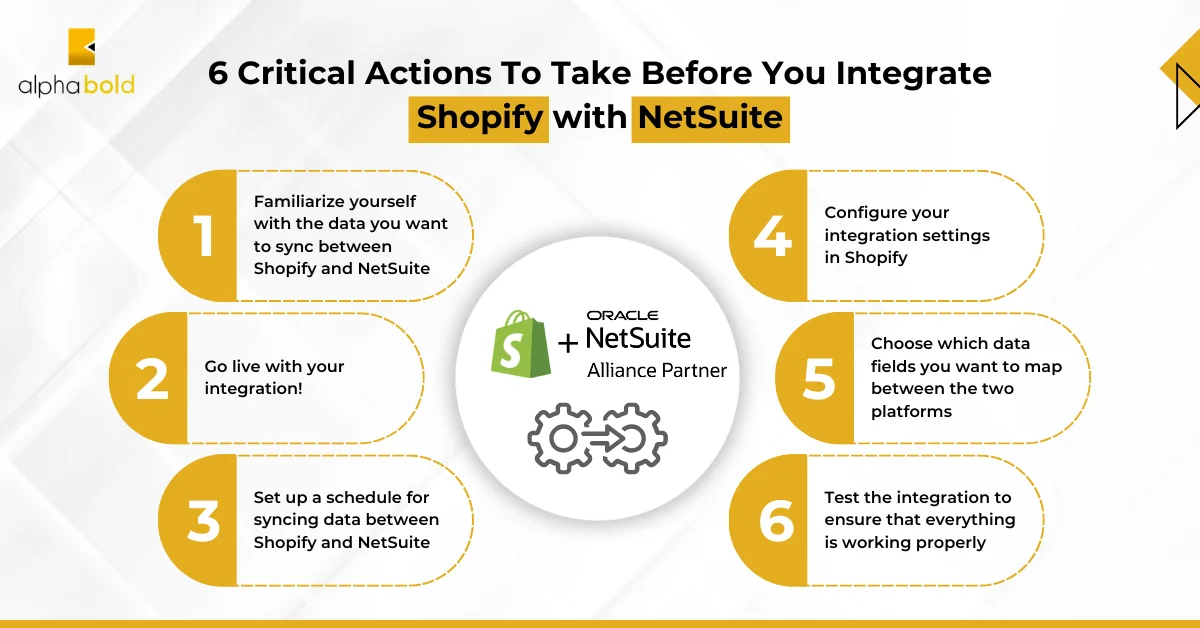
Infographics show the Critical Actions to take before you Integrate Shopify with NetSuite

Plan Your Shopify NetSuite Integration

AlphaBOLD helps you evaluate integration options, estimate costs, and implement and support the integration in NetSuite.

Request a Consultation

Conclusion

Disconnected or outdated Shopify and NetSuite integrations create duplicate work across orders, inventory, and finance, and the effect grows as B2B and POS sales expand. Weigh expected labor savings against subscription, implementation, and maintenance costs, and account for the API changes now underway. AlphaBOLD can help you evaluate your options, build a business case, and implement the integration that fits your operations.

FAQs

Why should businesses integrate Shopify with NetSuite?

Integrating Shopify with NetSuite eliminates manual data entry, improves order accuracy, and keeps inventory, customers, and financial data synchronized in real time. It helps businesses streamline fulfillment, reduce errors, and make faster, data-driven decisions.

Is the NetSuite Connector the official Shopify integration for NetSuite?

Yes. Oracle NetSuite publishes and supports the NetSuite ERP Connector on the Shopify App Store, covering Shopify B2C, B2B, and POS.

Can one NetSuite account connect to more than one Shopify store?

Yes, the NetSuite Connector and several third-party and iPaaS options can link multiple Shopify stores to one NetSuite account. Each store usually needs its own mappings.

Do we need to replace our integration because of the SOAP retirement?

Only if it relies on NetSuite SOAP web services. Confirm with your vendor, then plan a move to REST web services before SOAP is removed in 2028.2.

Can the integration help with Shopify payout reconciliation?

Yes, with the right tool. Some connectors and iPaaS flows bring payout, fee, and refund data into NetSuite to support reconciliation, so confirm which payout details each option syncs.

Explore Recent Blog Posts

Total cost includes the subscription, implementation and mapping work, and ongoing support as both platforms release updates. Oracle’s NetSuite ERP Connector is listed on the Shopify App Store at $199.92 per month for the B2C Standard plan, $249.92 per month for the POS and B2C Premium plans, and $916.58 per month for the B2B plan, with charges that may be billed by Oracle NetSuite separately from the Shopify invoice.

Copyright © 2025 AlphaBOLD | NetSuite Solution Provider | All Rights Reserved | Privacy Policy