
Table of Contents
Introduction
NetSuite change management has evolved far beyond simply training employees on a new ERP interface. As organizations navigate the second half of 2026, the scope of change ranges from net-new implementations and environment optimizations to preparing teams for sophisticated NetSuite 2026.2 capabilities, including Ask Oracle and NetSuite Next.
Each scenario requires a different plan, but the objective is the same: connect people, processes, data, and technology to measurable business outcomes. Without that connection, even a technically sound NetSuite environment can produce inconsistent adoption, manual workarounds, unreliable reporting, and disappointing ROI.
What Does NetSuite Change Management Cover?
NetSuite change management is the structured process of preparing the organization to adopt new NetSuite processes, roles, controls, and capabilities. It begins before configuration or enablement and continues through testing, rollout, stabilization, releases, and optimization.
The scope depends on the type of change:
- New NetSuite implementation: Process design, data migration, configuration, integrations, user acceptance testing, cutover, training, and go-live support. Organizations at this stage need a complete plan for change management during a new NetSuite implementation.
- Post-go-live optimization: Workflow improvements, role and dashboard refinement, reporting fixes, additional automation, retraining, and reduction of spreadsheet-based work.
- NetSuite Next adoption: Previewing the redesigned experience, evaluating Ask Oracle, confirming permissions, preparing users for AI-assisted work, and introducing the experience team by team.
NetSuite Next began rolling out with NetSuite 2026.2 for customers in the United States and Canada, with additional countries expected later. It builds on the existing NetSuite environment, so customers do not need a new implementation or data migration. They still need to determine which teams should adopt it first and how readiness will be assessed.
What Should Be Defined Before Training or Rollout Begins?
Organizations should define the business outcomes, owners, affected workflows, risks, and success measures before designing NetSuite training. Training employees before these decisions are settled can reinforce processes that will later change.
Start by answering five questions:
- Which business problem should this change solve?
- Which roles and processes will be affected?
- What must be configured, tested, or governed?
- How will readiness and adoption be measured?
- Who can approve changes and resolve exceptions?
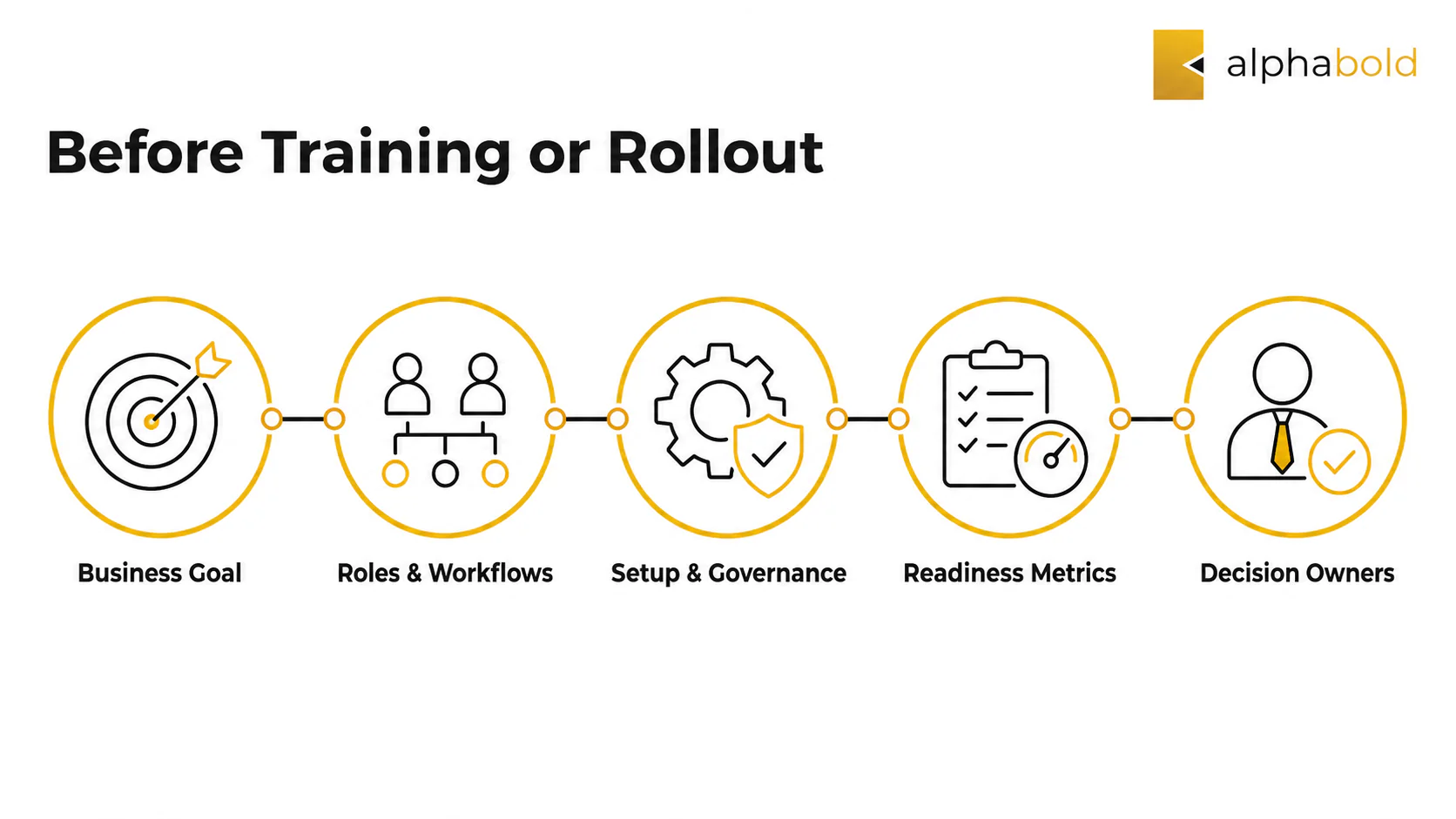
Ownership should include an executive sponsor, process owners, a NetSuite administrator, technical or integration leads, super users, and a change lead. This guide to building the right NetSuite project team explains how these responsibilities support accountability and adoption.
Baseline metrics should also be captured at this stage. Depending on the project, these may include close duration, transaction errors, order-processing time, support volume, spreadsheet dependence, report preparation time, or user completion rates.
How Should You Assess Process, Data, and AI Readiness?
Do not automate an inefficient process or introduce AI on top of unreliable data. Begin with a focused assessment of workflows, data quality, roles, reports, customizations, and integrations.
Financial process mining can help identify delays, repeated exceptions, rework, and deviations inside ERP processes. Teams should then decide which activities to standardize, simplify, automate, redesign, or retire.
Data readiness becomes more important when users rely on conversational analysis. Ask Oracle can answer questions about NetSuite data, locate records, generate analyses, and create canvases containing summaries, KPIs, charts, and tables. Its usefulness therefore depends on accurate records, consistent classifications, reliable reports, clear ownership, and appropriate permissions.
This connection is supported by 2026 research. Forbes reports that organizations with formal data quality processes are twice as likely to report strong ROI from AI. Before expanding NetSuite AI, review master data, custom fields, duplicate records, reporting structures, access restrictions, and integration quality.
Is Your NetSuite Environment Ready for Its Next Stage?
AlphaBOLD can assess your workflows, roles, data, integrations, customizations, and AI readiness before you expand adoption. Get a practical roadmap for introducing change without disrupting the processes your teams depend on.
Request a ConsultationWhat Governance Is Required for Ask Oracle and NetSuite AI?
NetSuite AI adoption needs defined access, acceptable use, human review, consumption monitoring, and escalation rules. Enabling a feature is not the same as preparing employees to use it responsibly.
Ask Oracle operates within existing NetSuite roles and permissions and can be enabled by role. Organizations should confirm what each role can see and do before rollout. Users should also know when to inspect the explanation behind a response, verify results against source records or reports, and escalate an uncertain answer.
AI usage has a financial dimension. Eligible NetSuite licenses include AI Units, and supported AI activities consume different amounts depending on their complexity. Administrators can monitor consumption through the Billing Information page. If the allowance is exhausted, the organization may need to purchase additional units or pause further AI use. A credible NetSuite ROI plan should therefore compare AI consumption with the value of the workflows it supports.
How Should NetSuite Changes Be Tested and Rolled Out?
Testing should validate complete business workflows, not just individual screens. Include roles and permissions, SuiteScripts, SuiteApps, forms, reports, saved searches, integrations, scheduled processes, approvals, and exception paths.
Use the correct environment for the objective. A NetSuite Release Preview account helps verify that existing workflows and customizations continue to function with a new release. A NetSuite Next preview account lets teams explore the redesigned experience and Ask Oracle using a copy of their environment.
Connected applications require their own test plan. These questions to evaluate before integrating with NetSuite can help identify data, ownership, security, and scalability risks.

For NetSuite Next, begin with a suitable pilot team, confirm readiness criteria, provide role-specific training, collect feedback, stabilize the experience, and then expand. A structured approach helped one medical technology company build a scalable NetSuite foundation while improving inventory accuracy, order processing, reporting, and operational scale.
How Should NetSuite Training Be Designed?
Effective NetSuite training should be role-based, process-based, and specific to the configured account. A finance user, warehouse employee, sales manager, and administrator should not receive the same learning path.
Training should combine:
- Real transactions and end-to-end scenarios
- Practice in an appropriate non-production environment
- Role-specific dashboards, permissions, and exception handling
- Short reference materials and embedded guidance
- Competency checks instead of attendance alone
- Refresher sessions after rollout and major releases

Ask Oracle training should cover how to frame questions, move from a conversation into a canvas, review explanations, validate outputs, provide feedback, and recognize when human judgment is required. NetSuite Guided Learning, MyLearn, SuiteAnswers, and role-based certification paths can complement account-specific instruction.
Training alone will not solve uncertainty about AI. Gartner’s 2026 workforce research found that only 27% of surveyed executives had a comprehensive AI strategy and just 20% believed their workforce was AI-ready. Leaders also need to communicate how roles will change, establish human-AI working norms, and create safe feedback channels.
What Should Happen After Go-Live?
NetSuite user adoption should be monitored through task completion, workflow consistency, process performance, data quality, support demand, and use of approved tools. Login counts alone do not demonstrate that employees are completing work correctly.
Relevant NetSuite success metrics after go-live include cycle time, automation rates, transaction errors, reporting accuracy, ticket trends, and user productivity. For AI-assisted work, also track successful use cases, output corrections, time saved, adoption by role, and AI Units consumed.
Change management must then become part of release readiness. Review new functionality, test affected workflows, update documentation, communicate user-facing changes, and provide targeted support. Recurring workarounds, unused functionality, slow processes, and inconsistent reporting are common signs that NetSuite needs optimization.
How Does NetSuite Change Management Improve ROI?
NetSuite change management improves ROI by increasing correct system use, reducing rework, accelerating processes, strengthening data quality, and helping teams adopt functionality that supports measurable business goals.
Compare post-change results with the baselines established at the beginning. Useful measures include:
- Financial close and reporting time
- Order-to-cash and procure-to-pay cycle time
- Manual entries, exceptions, and error rates
- Spreadsheet-based work and duplicate processing
- Support volume and resolution time
- User competency and task completion
- AI consumption relative to time, quality, or process improvements
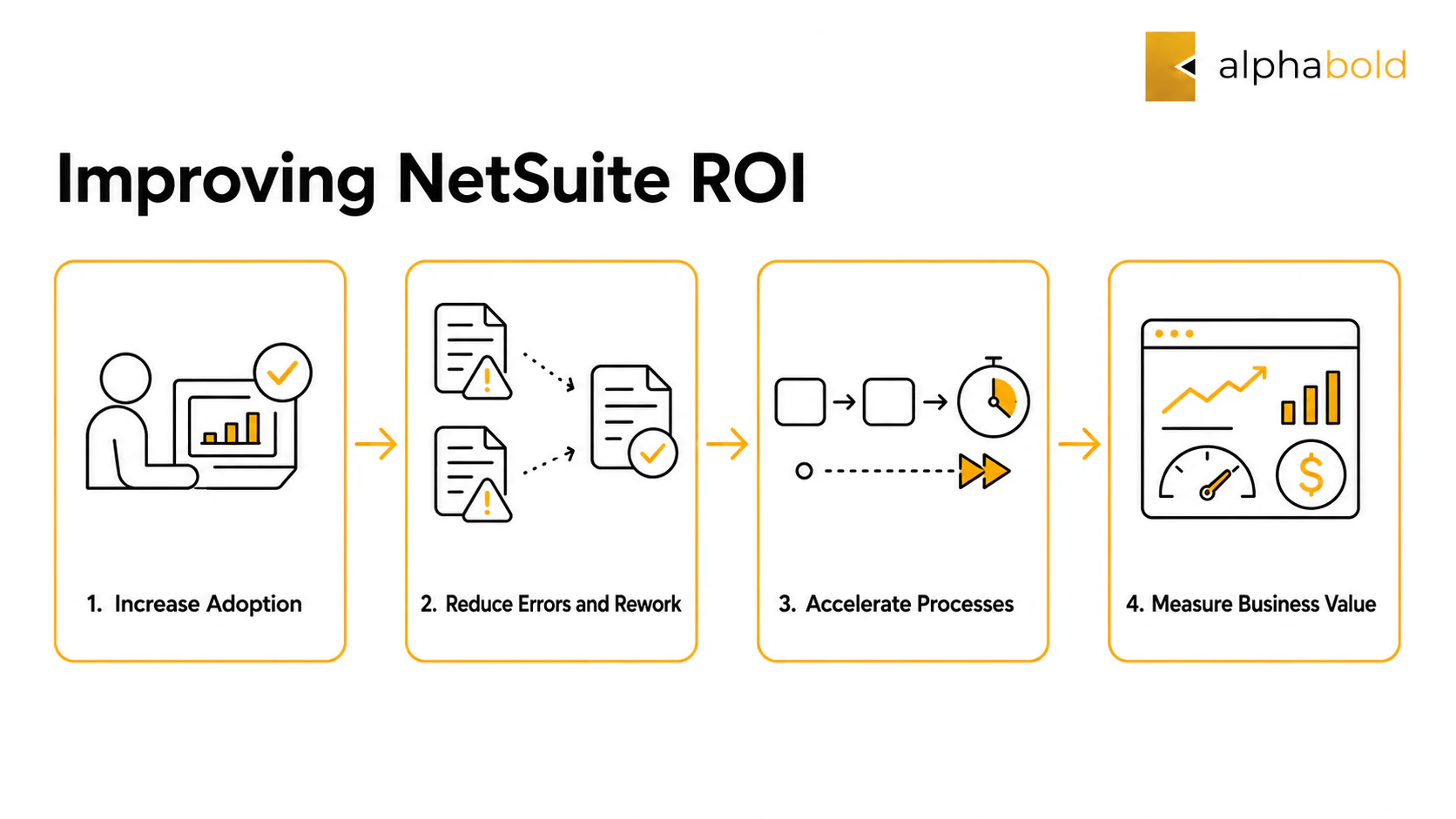
If results are not materializing, the response should not automatically be more training. The root cause may be poor configuration, unclear ownership, unreliable data, excessive customization, weak integrations, or a process that should be redesigned.
Turn NetSuite Adoption Into Measurable Business Value
AlphaBOLD helps organizations improve user adoption, optimize workflows, prepare for NetSuite changes, and measure performance after go-live. Let us identify where your environment is creating friction and where the next operational gains can come from.
Request a ConsultationConclusion
NetSuite change management extends beyond the temporary workstream surrounding implementation. In recent times, it is an ongoing discipline covering business alignment, process improvement, data quality, testing, role-based training, AI governance, release readiness, and performance measurement.
Organizations that manage these elements together are better positioned to turn NetSuite adoption into reliable operations and measurable ROI. Those that treat access or training completion as success may miss the process, data, and workforce issues limiting value.
FAQs
Does NetSuite Next Require Reimplementation or Data Migration?
No. NetSuite Next builds on the existing NetSuite environment and does not require reimplementation or data migration. Organizations should still preview the experience, validate roles and workflows, train users, and introduce it team by team.
How Should Employees Be Trained to Use Ask Oracle?
Training should cover role-appropriate use cases, question framing, canvases, explanations, output verification, feedback, AI governance, and escalation. Users must understand that access and responses depend on their NetSuite roles and permissions.
What Are NetSuite AI Units?
AI Units measure consumption across supported NetSuite AI features. Usage varies by task complexity. Administrators can monitor consumption, and organizations may need additional units if they exceed their licensed allowance.
How Can a Company Measure NetSuite User Adoption?
Measure whether users complete core processes correctly in NetSuite. Track task completion, cycle time, errors, workflow adherence, spreadsheet dependence, support tickets, reporting quality, user competency, and measurable business outcomes.